Javascript Codes

Friday, October 31, 2014

South Sudanese refugees face flooding and difficult dynamics in Ethiopia

South Sudanese refugees face flooding and difficult dynamics in Ethiopia

Amid fears of renewed conflict in South Sudan, ethnic rivalries are complicating efforts to move refugees from flooded camps
South Sudan
Refugees wade through flood waters at Leitchuor camp in Gambella, Ethiopia. Built on a floodplain, the camp is now largely submerged. Photograph: Will Davison
For the war refugees who have escaped ransacked South Sudanese towns and impoverished villages, and for the aid workers assisting them in the western Ethiopian region of Gambella, now is a time for waiting.
Mary Ban, 26, has been stuck in a camp on the Ethiopian border during the rainy season, sleeping in a large communal tent with her four children. They’ve got no mosquito nets or sheets, and she’s not happy with the grain distributed by the UN as it causes diarrhoea. But because the Tierkedi and Kule camps are full, and Leitchuor camp flooded, she will have to remain in Pagak for a while.
“I am waiting to be relocated,” she says, pausing from bundling firewood to sell. “We will be here until we [are] taken to the place we need.”
The uncertainty in the refugee operation is twofold. Though a difficult situation is under control for now, many believe heavy fighting will resume in South Sudan once roads dry up, leading to a new surge of tens of thousands of refugees. Moreover, Ethiopia’s government is struggling to find suitable locations for flooded refugees and potential new arrivals that do not disturb volatile local political dynamics.
Ban, an ethnic Nuer from Mathiang in Upper Nile state, has been offered space at a camp along with 3,000 other people at Pagak. Only 12 accepted. That is because the camp is more than 250 miles away, in the south of Gambella – far from the Nuer strongholds in the region and close to their ethnic rivals, the Dinka.
“We need to be in Kule, but we don’t want another area. We don’t like Dima, as it’s near to the Dinka side. Dinka came to Mathiang and killed a lot of people; children, women and old people,” she said.
Ban is one of almost 200,000 primarily Nuer refugees who have ended up in Ethiopia since December 2013, when attempts by Kiir to arrest political rivals for coup plotting – including his Nuer former deputy, Riek Machar – prompted commanders to rebel. The ensuing clashes have claimed thousands of lives and displaced nearly 2 million people (pdf).
Ceasefire deals have been signed in Addis Ababa, but in reality it is the rainy season that has discouraged the movement of potential refugees and armed groups. The result has been a huge reduction in people crossing the border, despite severe food shortages inside South Sudan.
Aid organisations nonetheless remain alert: fading rains could lead to renewed fighting, causing a surge comparable to the first few months of the crisis, when thousands a day were arriving.
“That’s why humanitarian agencies are working with a 100,000-extra influx in the latest months of the year,” explains Dennis Solberg Kjeldsen, regional operations coordinator for the International Federation of Red Cross and Red Crescent Societies. “So right now there’s a little bit of a lull … but we’re quite sure we’re going to need the resources, we’re going to need funding.”
Funds are in heavy demand because of the exceptional number of emergencies occurring globally, not least the Ebola outbreak. “I don’t want to underestimate or downplay the threat of Ebola, but Ebola has taken an enormous amount of attention away from ongoing emergencies on the continent,” he said. The UN refugee agency has received 37% of the requested $567m (£355m) needed to deal with the 2 million displaced inside and outside South Sudan.
Aid workers are also waiting for Ethiopia’s federal and regional governments to settle on an alternative to the existing Okugu camp near Dima.
Aside from the refugees’ fears regarding the Dinka, there are tensions in Gambella (pdf) between the Nuer and the Anuak people, another Nilotic ethnicity, which complicate the decision. Although Gambella is one of Ethiopia’s most sparsely populated areas, access to its plentiful land and water is contested. Because of its fertility, the federal government hasearmarked the state for commercial agriculture.
The Anuak, who consider themselves the original inhabitants of the area, feel encroached upon by the now more populous Nuer, and also threatened by foreign and highland farming investors. This year’s influx of Nuer – equal to 60% of Gambella’s 2007 official population of 307,000 – is only the latest instalment in a century-old trend. The rate of arrival has increased in the five decades since the southern Sudanese began their struggle against Khartoum.
Anuak discontent manifests itself in sporadic violent clashes, most recently with highlanders. In 2012, Anuak rebels killed workers at a prominent rice farm, leading to reprisals by security forces. A scuffle between schoolchildren this month led to a series of tit-for-tat killings and mob violence between Anuak and highland communities in Abobo and Gambella towns, according to Anuak elders and local security sources. The scars of a 2003 bout of violence – when, according to Human Rights Watch, soldiers and militias targeted Anuak civilians after acts of banditry – have barely healed. Anuak people fear a repeat of what some call a massacre.
There is also resentment at the arrivals from the west. One of the Anuak elders, Ochodo Obang, sees all Nuer settlers as foreign colonisers. “These people are like the highlanders; they want to take our land. We are the owners of the land.
“We don’t want them to be here at all. It’s not a question of do we put them here or there.”
The problem for officials is how to accommodate tens (and possibly hundreds) of thousands more Nuer in the next few months without stoking disputes. The dry and stable Kule and Tierkedi camps that house about 100,000 people are in former Anuak areas, Ochodo says. The ill-fated government decision to choose Leitchuor camp – located in a floodplain, it is now largely submerged – resulted from a lack of good options.
“There’s a lot of difficult issues around it, not least the ethnic dimensions,” said Kjeldsen of the government’s choice. “We have to be careful we don’t exacerbate any tension.”
Source: theguardian.com

Thursday, October 30, 2014

Okanagan surgical team bound for Ethiopia

Okanagan surgical team bound for Ethiopia

Global News
KELOWNA– A group of Okanagan doctors, nurses and Rotary Club volunteers are part of a 21 person, all Canadian team heading to Ethiopia.
As part of Rotoplast Canada, the team will take over a hospital in the community of Bahir Dar for two weeks to perform life changing surgeries on mostly women and children.
They will repair cleft lips and cleft palates as well as provide burn treatment and gynecological surgeries.
In Africa’s tribal culture, people with physical injuries and abnormalities are often shunned.
Children may not be allowed to go to school and husbands often leave wives who are damaged by multiple pregnancies.
The team isn’t just providing medical care, it’s also providing an education component for local medical workers.
The goal is to open a satellite burn treatment centre in Bahir Dar within the next three years.
It means people outside of major centres in Ethiopia will have on-going access to treatment.
The team expects hundreds of people to show up for surgical screening.
Doctors will only be able to treat between 60 and 80 patients during the two week stay but many more locals will have access to long term treatment thanks to the training and equipment left behind.
The mission is partially funded by Rotary International which mandates that the program be sustainable.

Wednesday, October 29, 2014

Ethiopia to deploy health workers to Ebola-stricken West Africa

Ethiopia to deploy health workers to Ebola-stricken West Africa

By Tesfa-Alem Tekle
October 24, 2014 (ADDIS ABABA) – Ethiopia has announced that it is sending health professionals to Ebola-hit West African nations as part of ongoing collective efforts to contain the outbreak of the deadly virus.
At a news conference on Friday, Ethiopian health minister Kesetebirhan Admassu said the Horn of Africa nation will deploy 200 volunteer health professionals to West Africa.
Ethiopia’s decision comes one week after the African Union (AU) appealed to member states to contribute health workers to avert the outbreak, which also has become an international threat.
Admassu said the deployment, which will take place in two rounds, was also a “sign of solidarity” to the countries affected by the epidemic.
“Our support to West Africa will mainly focus on three areas: case management, supporting disease surveillance in the affected countries and proper organisation of community care, which Ethiopia is better able to deliver,” he told Journalists.
The health minister said those Ethiopian professionals due to be deployed will include medical doctors, nurses, field epidemiologists, environmental health and public health specialists.
Addis Ababa has also pledged $500,000 to help support the three most-affected countries, namely Guinea, Sierra Leone and Liberia.
AU chief Nkosazana Dliamini Zuma said other African countries have also pledged to send some 1,000 volunteer health workers to the Ebola-stricken countries.
According to the World Health Organisation (WHO), Ebola has killed nearly 5,000 people since the outbreak was reported some eight months ago.
Among the death toll is 443 health workers, of whom 244 have died, said the WHO.
Mali became the latest West African country to be affected by the virus, after the death of a two-year-old girl last week.
The disease has also spread to the West, with cases reported in the US and Europe.
The current outbreak is the deadliest since Ebola was discovered in 1976 and has raised fears of a global epidemic.

Source: Sudantribune

Friday, October 24, 2014

Humanitarian trip prompted Ebola panic

  • Humanitarian trip prompted Ebola panic

    Looking at some of the gifts that they were given, Ingrid and her daughter, Amelia Burke, 12, just returned from a trip to Ethiopia on Monday, where Ingrid and a doctor friend delivered equipment and provided training at a hospital to help screen for cervical cancer to treat women for precancerous lesions. Some parents at Amelia's school, Rondout Valley Central School District, were upset about her trip to Africa because of the Ebola scare, and did not let their children attend classes. JIM SABASTIAN/For the Times Herald-Record|
     
    Looking at some of the gifts that they were given, Ingrid and her daughter, Amelia Burke, 12, just returned from a trip to Ethiopia on Monday, where Ingrid and a doctor friend delivered equipment and provided training at a hospital to help screen for cervical cancer to treat women for precancerous lesions. Some parents at Amelia's school, Rondout Valley Central School District, were upset about her trip to Africa because of the Ebola scare, and did not let their children attend classes. JIM SABASTIAN/For the Times Herald-Record
  • Looking at some of the gifts that they were given, Ingrid and her daughter, Amelia Burke, 12, just returned from a trip to Ethiopia on Monday, where Ingrid and a doctor friend delivered equipment and provided training at a hospital to help screen for cervical cancer to treat women for precancerous lesions. Some parents at Amelia's school, Rondout Valley Central School District, were upset about her trip to Africa because of the Ebola scare, and did not let their children attend classes. JIM SABASTIAN/For the Times Herald-RecordAmelia Burke, far right, on her recent trip to Ethiopia.
    • By Heather Yakin
      Times Herald-Record 

      Posted Oct. 23, 2014 @ 8:12 pm
      Updated Oct 24, 2014 at 10:15 AM 


      HIGH FALLS – While nurse-practitioner Ingrid Frengle-Burke and Dr. Maggie Carpenter were in Ethiopia with their kids on a humanitarian trip to save women’s lives, a group of Rondout Valley parents lobbied school and public officials to keep Frengle-Burke’s daughter out of classes upon her return.
      These parents were convinced that 12-year-old Amelia Burke had been exposed to Ebola.
      Never mind that the women and kids were in Gondar, Ethiopia, more than 3,000 miles from the outbreaks in the West African nations of Liberia, Sierra Leone and Guinea. Dallas is closer to New York than Ethiopia is to Liberia.
      Before the trip, Amelia said, some kids had been joking that she might get Ebola.
      “I guess parents were informed,” she said. “I guess that’s when everyone started freaking out.”
      Frengle-Burke said they were still in Africa when she started hearing from friends that people were asking the district to ban Amelia from school for three weeks — the Ebola incubation period – after their return. There were even rumors that Amelia had been working with Ebola patients.
      Frengle-Burke tried explaining where they were, and that there was no outbreak in Ethiopia. She said the critics countered with a questionable Internet article that claimed there was a case in Ethiopia.
      “It’s just so seated in fear,” Frengle-Burke said.
      The Rondout Valley School District administration consulted the district doctor and the county health commissioner, and ended up simply issuing a statement telling parents there was no elevated health risk.
      “This was the focus, and we went over there to do this amazing work," Frengle-Burke said.
      Carpenter had started a nonprofit group, Go Doc Go (www.godocgo.org), so she could raise funds to buy equipment and provide training to doctors at the University of Gondar Hospital in Gondar, Ethiopia, in eastern Africa. On a trip several years ago with a medical residency exchange program, she’d learned that the hospital didn’t have the equipment or training to screen women for cervical cancer – not even for Pap smears. Cervical cancer kills more women each year in Ethiopia than either AIDS or childbirth, Carpenter said.
      In September, Go Doc Go had raised the money needed for equipment and training materials to locate and remove lesions. Carpenter and Frengle-Burke set out on their mission Oct. 11, taking Amelia and Carpenter’s 14-year-old son, Julian Lewis, along for the experience.
      While at the hospital they screened 20 women and were able to treat two of them for precancerous lesions, Frengle-Burke said.
      The families also explored Gondar and went hiking and camping in the mountains. They visited an elementary school.
      “It was very fun, and it was very different,” Amelia said. “It was cool to see the difference between where we live and there.”
      The four returned home on Monday, and that’s when Frengle-Burke got the full picture of the group of parents’ intense lobbying.
      “I think they (the school district) entertained these folks for too long, which gave them credibility,” Carpenter said. “It was an amazing trip, and it certainly doesn’t take away from that.”
      Julian has had no such pushback in New Paltz.
      Wednesday was Amelia’s first day back at school, and the day passed without problems.
      She’s amazed at the panic their trip sparked.
      “I think it’s ridiculous,” Amelia said. “I don’t think it’s very sensible.”

    UGANDA, KENYA FALL AS TANZANIA, ETHIOPIA RISE IN LATEST FIFA RANKINGS

    Uganda Cranes line up before their 1-0 loss to Togo
    Uganda has fallen five places according to the latest Coca Cola FIFA rankings released on Thursday October 24.
    Uganda; 79th last month is now ranked 84th in the world and 21st in Africa with 389 points.
    The fall is attributed to the back-to-back losses to Togo in the Africa Nations Cup qualifiers and Uganda Cubs' (U-17) failure to go past Zambia in the Africa Youth Championship qualifiers.
    Neighbours Kenya have also fallen five places from 111st to 116; a fall attributed to losses against Morocco and Egypt in international friendlies.
    However, there was rise for Tanzania and Ethiopia who are now ranked 110 and 111 in the world respectively. Ethiopia were the biggest movers rising 21 places from 132 last month.
    Uganda’s opponents in group E of the AFCON qualifiers Ghana dropped two places to 35th (5), Togo rose 72 places to 52nd (10) whilst Guinea dropped 7 places to 55 (11).
    World champions Germany maintain top spot followed by Argentina, Colombia, Belgium and Netherlands in that order.

    Wednesday, October 22, 2014

    Mining in Ethiopia Could Be a $5 Billion Industry

    Mining in Ethiopia Could Be a $5 Billion Industry

    According to a report from Ventures Africa, Ethiopia could be sitting on a rather large economic opportunity. A 2013 study indicated that the mining sector – including tantalum deposits in that country – could be worth as much as $5 billion.
    As quoted in the publication:
    Already, according to Mines Minister Tolosa Shagi, Ethiopia had already realized more than $2.3 billion from the exports of gold, tantalum, opal, marble and other minerals over the past four years, and returns should double with more investment in the sector.
    In 2013, the Ethiopian government collaborating with the World Bank commissioned a report titled “Strategic Assessment of the Ethiopian Mineral Sector,” results from which, also validated by private companies and geological surveys, states clearly that the East African country had a wide range of possibilities for the exploitation of mineral deposits.
    Mines Minister Tolosa Shagi said:
    Exploratory activities conducted to date in limited parts of the country indicate that Ethiopia is endowed with a favourable geological environment that hosts a wide range of mineral and geo-energy potential. More than 130 companies are working in solid minerals operations and oil and gas activities in Ethiopia. However, there is still a need to develop adequate transport and accountability systems to ensure that the development and management of resources is conducted effectively.

    Meningococcal Meningitis A vaccination campaign launched in Ethiopia

    A campaign to vaccinate 27 million Ethiopians against Meningococcal Meningitis A was launched Sunday in target regions of the country. This second phase preventive campaign is targeting people aged between one and 29 years in 39 zones of Southern Nations, Nationalities and Peoples Region (SNNPR), Oromia and Addis Ababa.
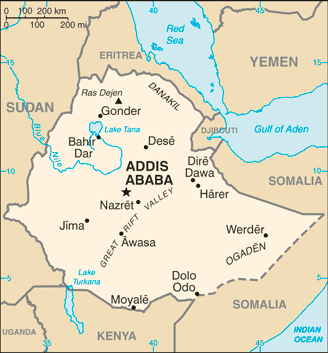
    Ethiopia, Africa
    Ethiopia
    Image/CIA
    A Meningitis risk assessment conducted by WHO in 2012 determined the risk profile by region and, with support from the Global Alliance for Vaccines and Immunization (GAVI), Ethiopia launched large scale campaigns in three phases targeting all regions over a period of three years under the leadership of the Federal Ministry of Health. The first phase, conducted in October 2013, successfully reached 19 million people.
    The largest burden of Meningitis occurs in Sub-Saharan Africa, known as the ‘Meningitis Belt’ that stretches from Senegal in the west to Ethiopia in the east. Neisseria meningitidis is recognized as the leading cause of Meningitis with sero-group A identified as the dominant cause of the disease.
    Through the Meningitis Vaccine Project (MVP), a new Meningococcal A Conjugate vaccine, “MenAfriVac®”, has been developed for the African Region, to provide a preventive measure through mass vaccination campaigns. Meningococcal A Conjugate vaccine has the major advantage of providing longer and stronger protection, and rapidly inducing herd immunity even among children below two years. Vaccination campaigns have been conducted in several countries in the African region with remarkable outcome.
    The MVP, a partnership between WHO and the Program for Appropriate Technology in Health (PATH), was created in 2001 with core funding from the Bill & Melinda Gates Foundation. Its goal is to eliminate epidemic Meningitis as a public health problem in Sub-Saharan Africa.
    A launching ceremony in SNNPR was held at the Regional Capital, Hawassa, officiated by the Regional Health Bureau, the Government Council, government sectors and a cross-section of stakeholders, including religious and community leaders and partners.
    In Oromia Region, vaccination activities were kick-started in Bishoftu and Sebeta towns, Fine-Fine Zuria and Bale zones.
    The Federal Ministry of Health and the respective regional health bureaus, with support from GAVI, WHO, UNICEF and other partners, coordinated the intensive preparations for the large-scale campaign that will be implemented over a ten-day period.

    Thursday, October 16, 2014

    Belarus to resume tractor assembling in Ethiopia

    Belarus to resume tractor assembling in Ethiopia

    15 October 2014 13:26  |  Economy
       Decrease font size  Restore the original size  Increase font size 
    Belarus to resume tractor assembling in Ethiopia
    Belarus to resume tractor assembling in Ethiopia
    MINSK, 15 October (BelTA) – Belarus plans to resume the assembling of Belarusian tractors and other agricultural equipment in Ethiopia. The agreement was reached during the Belarusian-Ethiopian ministerial consultations at the level of the deputy foreign ministers, BelTA learnt from the press service of the Foreign Ministry of Belarus.

    The consultations were held as part of the visit of Deputy Foreign Minister of Belarus Valentin Rybakov to Ethiopia. Valentin Rybakov and State Minister of Foreign Affairs of Ethiopia Berhane Gebre-Christos discussed the Belarusian-Ethiopian political dialogue, trade and economic cooperation. Special attention was attached to an exchange of visits and trade and economic cooperation prospects. The parties discussed instruments that can be used to enhance the efficiency of trade and economic cooperation. They also agreed to provide assistance to the intergovernmental commission on trade and economic cooperation, the organization of business forums and exchanging business delegations.

    The parties considered an opportunity of using the Belarusian experience and know-how in the implementation of promising projects in the agricultural sector, the prospects for Belarusian companies to take part in the implementation of infrastructure projects in Ethiopia. The deputy ministers analyzed the current status of the legal framework of the Belarusian-Ethiopian cooperation and discussed necessary steps to expand it, including the preparation and signing of agreements on trade cooperation, mutual protection of investments, and cooperation in education. 

    Agreements were reached to intensify cooperation in the UN and other international organizations (the UN Human Rights Council, the ECOSOC, Non-Aligned Movement) and also to provide mutual support to the initiatives of Belarus and Ethiopia and their candidacies in these organizations. The Foreign Ministries will enhance Belarusian-Ethiopian contacts in the field of education and science.

    The Ethiopian Chamber of Commerce held a business forum for representatives of the Belarusian and Ethiopian business communities. On behalf of Ethiopia, the event was attended by about 60 businessmen interested in developing business cooperation with Belarus. The Belarusian Embassy in Ethiopia held a presentation of the economic and export opportunities of Belarus, prospects for trade and economic cooperation with Belarus. A cooperation protocol was signed between the Belarusian Chamber of Commerce and Industry and the Ethiopian Chamber of Commerce.

    The Belarusian delegation to Ethiopia comprises representatives of the Industry Ministry, MAZ, MTZ, and other Belarusian companies and organizations. 

    Wednesday, October 15, 2014

    ETHIOPIA: A JOURNEY TO TEARS OF JOY

    ETHIOPIA: A JOURNEY TO TEARS OF JOY


    I'm back from my dreamlike Ethiopia visit. After a one-week break from chaos in the amazing country, I am still trying to get used to my old life. I am in Istanbul now but I think I have forgotten my heart and my mind there. If someone told me before I would never have believed that I would get so inspired. I don't know if my country's politically unrestful situation makes me more emotional and if Ethiopia is an escape for me. Following six days without Internet, telephone and sometimes electricity, finding Turkey in a more stirred position made me a bit depressed, of course.

    But no, Ethiopia is more than that. Ethiopia is a magical chamber that made me have so many feelings. From the first moment I stepped out from Bole International Airport, the weather anaesthetized me. It was fascinating when I traveled to a rural area the next day. All the hues of green hypnotized me. I remember that I couldn't believe that I was not in Ethiopia and I had not come to New Zealand by mistake. I also questioned how such a fertile country that could feed all of Africa be so poor. A few days later, when I visited the orphan homes, it was stunning. I met the beautiful children of Ethiopia, desperate but lovely orphans, and they melted my heart with their big smiles and bright eyes.

    I have to say that I am not a person who loves taking photos or having photos taken of me. Indeed, I really get annoyed when people start shooting next to me. But there I couldn't put down my camera as all of the scenes I saw needed to be recorded and never forgotten.

    Believe it or not, I am not someone who loves traveling, going to the countryside or walking on the earth. As I injured my leg recently, I have pain even jogging. But in Ethiopia, I really enjoyed those activities and never felt pain. In fact, I am known as being a cold person. In Ethiopia, I was surprised with myself as I couldn't get enough of hugging the children and couldn't take my eyes off the beauty of the orphans.

    According to a UNICEF report, Ethiopia is home to one of the largest orphan population in the world with 4.6 million orphans from a population of 90 million, which is 5 percent of the total population. Ethiopia endured a massive draught two decades ago and conflicts left thousands of children orphaned. Facing famine, hunger and untreated diseases, approximately one in six Ethiopian children die before the age of five, statistics say. The hardship and the needs for volunteer programs can easily be seen in the villages of Ethiopia. But the adoption practices in the country carry a threat, as organizations like UNICEF have long point out since, as adoptions have become an international market. Keeping children together with their siblings, single parents or other relatives should be of primary importance for volunteers. Raising children in their own country, connecting orphans with their families and supporting families with education as well as financial support double and triple the recovery.

    While I was visiting some of the around 2,500 orphans' homes supported by IHH Humanitarian Relief Foundation under the orphan sponsorship program conducted in cooperation with IHH's regional partner, Charity and Development Association (CDA), I witnessed that local programs have vital importance. I met with single parents who survived by begging and now send all of their children to university, with single mothers who started to look after two other orphans after they secured the future of their own children. I heard that a female neighbor of an orphan family said, "I need my husband died for the sake of my children," making a point of the success of IHH and CDA's orphan sponsorship program.

    That's how those orphans melted my heart with their smiling faces. That's how they made me burst into tears of joy. That's how I saw that sharing saves lives. That's how I experienced that true love and true mercy is the way of hope and happiness. That's how I can say what CDA and IHH do in Ethiopia is saving lives, connecting families, maximizing opportunities and providing happiness. 

    Source: dailysabah.com

    Ethiopian and Egyptian officials meet to resume Nile water talks

    Ethiopian and Egyptian officials meet to resume Nile water talks


    Water Resources and Irrigation Minister Hossam El-Moghazy met with Ethiopia’s Ambassador to Egypt, Mahmoud Derir, on Tuesday in Cairo, regarding preparations for the Grand Ethiopian Renaissance Dam (GERD) National Committee. (Photo from Water Resources and Irrigation Ministry)
    Water Resources and Irrigation Minister Hossam El-Moghazy met with Ethiopia’s Ambassador to Egypt, Mahmoud Derir, on Tuesday in Cairo, regarding preparations for the Grand Ethiopian Renaissance Dam (GERD) National Committee.
    (Photo from Water Resources and Irrigation Ministry)
    Water Resources and Irrigation Minister Hossam El-Moghazy met with Ethiopia’s Ambassador to Egypt, Mahmoud Derir, on Tuesday in Cairo, regarding preparations for the Grand Ethiopian Renaissance Dam (GERD) National Committee.
    The committee, which is expected to commence meetings by the end of this week, is likely to include Egyptian experts and researchers in the field, according to the ministry.
    Derir’s visit comes at a time of high-level talks between the two countries, in attempt to reach a common position on GERD, which is currently under construction.
    Foreign Minister Sameh Shoukry assured his Ethiopian counterpart during their September meeting at the UN General Assembly in New York, that he will visit Ethiopia to maintain momentum on the Nile water talks.
    President Abdel Fattah Al-Sisi and Ethiopian Prime Minister Hailemariam Desalegn met in June on the sidelines of the African Union summit in Malabo. The two countries later announced their decision to form a joint committee within three months to streamline discussions on GERD.
    GERD, which is currently 30% complete, according to Ethiopian Government press statements in February, is a hydroelectric power dam. It has raised concerns from the Egyptian government over its share of the Nile river water.

    Monday, October 13, 2014

    Ethiopia eyes $2.5bln revenues of agricultural exports

    Ethiopia eyes $2.5bln revenues of agricultural exports

    The target is taking into consideration the growth of agricultural products, market system efficiency, capacity of the exporters and suppliers of the products

    World Bulletin/News Desk
    Ethiopia is planning to earn a total of over $2.5 billion revenue from its exports of agricultural products during the current budget year, which began in July, an official with the Ministry of Trade said on Sunday.
    "The stated amount of revenue will be secured from the export of more than 1.1 million tons of agricultural products," Abdurrahman Se’id, Public Relation Deputy Head of the Ministry, told Anadolu Agency.
    He said the products include coffee, oil seeds, cereals, khat, spices, natural gum and incense among others.
    “The revenue is projected to surpass by 16.3 percent that of the $2.1 billion income earned during the previous budget year,” he added.
    The target is taking into consideration the growth of agricultural products, market system efficiency, capacity of the exporters and suppliers of the products, he said.
    The biggest export item will be coffee followed by oil seeds, Se’id said.
    Around $862 million of the total revenue is expected from the export of coffee, which contributes the lion’s share in the country’s economy, he said.
    “The country will also export 362,422 tons of oil seeds and secure over $724.8 million revenue in this fiscal year,” he added.
    Coffee is believed to have been first discovered in Ethiopia’s south-west region of Kaffa/Caffa, with its name derived from the region.
    Africa's largest coffee producer, Ethiopia generated some $718 million from coffee exports during the 2013/14 financial year.

    ETHIOPIA'S REGASSA WINS EINDHOVEN MARATHON IN 2:06:21

    Tilahun Regassa is starting to amass a more-than-respectable marathon record after winning the 2014 De Lage Landen Marathon Eindhoven in 2:06:21 on Sunday (12).
    The victory took his tally to two out of his four outings over the classic distance, both his victories coming on Dutch roads having also won the 2013 Rotterdam Marathon.
    The Ethiopian made a decisive surge in the 36th kilometre in Eindhoven to quickly put daylight between himself and his main rivals.
    In addition to putting his fellow runners well behind him, the burst of acceleration also helped him forget all the worries of a slight left knee injury which had troubled him in the weeks prior to the race, and even on the start line.
    “It was something that was bothering me throughout the race but only a little bit,” said the regular training partner of distance running great Kenenisa Bekele. "When the pace was about 63 minutes at halfway, I was happy as I could feel that my knee was OK at this pace and so I am very happy to have the win, and not unhappy about missing the course record or my personal best (2:05:27)."
    The race started in perfect conditions for fast times – 10 degrees Celsius, slightly overcast and almost no wind – and the weather stayed calm for the rest of the morning.
    After a relatively sedate first 5km in 15:10, a leading group of eight reached 10km in 29:39.
    The group contained Regassa, his compatriot Deriba Merga, and the Kenyan trio of Jonathan Maiyo, Leonard Komon and Richard Sigei, as well as three Kenyan pacemakers: Sammy Kigen, Victor Kirui and Alfers Lagat.
    The group was still packed tightly at 15km, passing in 44:31, and stayed together for the next seven kilometres as 20km was reached in 59:36 and then the halfway point passed in 1:03:05.
    The pack started to break up shortly after halfway, with Kirui stepping to the side of the road. Merga and Komon started to drift off the pace in the 23rd kilometre.
    Now down to five, including pacers Kigen and Lagat, 25km was reached in 1:14:25.
    Sigei was the next to weaken and he could not stay with Regassa and Maiyo for much longer but the remaining quartet went through 30km in 1:29:22, at which point it looked possible that Dickson Chumba’s course record of 2:05:46 from 2012 might fall.
    However, all thoughts of records started to diminish in the next 5km stretch before the four runners reached 35km in 1:44:36.
    Shortly afterwards, Regassa seemed to sense it was the right moment to throw down the gauntlet and nobody else picked it up.
    Lagat, who had been given the green light at 35km by the race director Peer Pulles, along with Kigen, to finish despite his initial role as a pacemaker, initially held second place after Regassa’s breakaway until Maiyo started to show his experience and strength, and overtook his compatriot just before 39km.
    However, Regassa also had plenty in reserve and had no problem keeping Maiyo at bay for the remainder of the race. The Kenyan eventually crossed the line second in 2:06:47.
    Lagat, despite tiring over the final three kilometres, finished his first marathon in 2:07:11.
    Komon, of whom much had been expected considering his credentials over shorter distances on the roads, finished a very disappointed sixth in 2:14:25.
    “At 23km my legs started to feel very tired but I was determined to finish," said Komon, the world record-holder for 10km and 15km. "During the last hour of the race I asked myself a lot of questions. I did a lot of thinking in the final 15km as I was passing nobody other than joggers (on the first lap of the two laps of the city)."
    The first woman home was Poland's Iwona Lewandowska in 2:28:33, just one second outside her personal best.
    Lewandowska was out on her own in the women’s race almost from the gun, although helped by male runners around her, and she passed halfway in 1:13:46 before becoming the first Polish woman to win in Eindhoven.
    She also took the World Military Marathon Championships title, an event run in conjunction with the race. The men’s gold medal in the championships also went to Poland with former European junior 3000m steeplechase champion Marcin Chabowski finishing eighth overall in 2:15:04.

    Kenyan, Ethiopian Win Sofia Marathon

    Kenyan, Ethiopian Win Sofia Marathon

    Bulgaria: Kenyan, Ethiopian Win Sofia Marathon
    Photo by BGNES
    Kenyan Athlete Edwin Kipchumba and Ethiopia's Zerife Boku were the fastest contenders at Marathon Sofia's 31st edition held on Sunday, October 12.

    Kipchumba went through the 42.195 km in 2:19.06 h. He came first after closing in on other participants and taking the lead just in the last 5 kilometers.

    Boku, who had been considered most likely to win, was first among the women with a time of 2:40.53 h.

    Shaban Mustafa was the fastest Bulgarian, ranking seven with 2:25:01, according to the sports website Gong.bg.

    Sofia Mihaylova, who has scored victory in the marathon a total of seven times, finished fourth with 2:58.51.

    Some 279 people from 35 countries took part in the race.

    The winners will receive BGN 5 000 each and a BMW electric bike at roughly the same value.
    Kenyans and Ethiopians also topped the 2-5 places in the men's rankings.
    The event met some criticism for putting athletes on an equal footing with non-professionals.

    Kevin Wright Shares Ethiopia's Top Ten Religious Highlights

    Kevin Wright Shares Ethiopia's Top Ten Religious Highlights

    Kevin Wright Shares Ethiopia's Top Ten Religious Highlights

    PHOTO: The Churches of Lalibela were carved out of solid rock. (Photo by David Cogswell)
    Ethiopia is emerging from the shadowy sidelines of the world community and joining the global travel industry, bringing its attractions to market. The richness of the country’s historical sites will surprise most people who have never visited the country before. Besides its fertile sub-saharan landscape and natural wonders, the East African country has a wealth of historical sites, and many major religious sites.
    NTA (National Tour Association) recently conducted a Product Development Trip to Ethiopia, sponsored by the Ethiopian government, to introduce American tour operators to the country’s tourism possibilities.
    The NTA PDT Ethiopia took a small group of tour operators and some travel reporters for a quick overview tour of Ethiopia. The itinerary was designed to pack as much of Ethiopia’s most compelling attractions into the time allowed as possible. In 10 days, there was only time for a rough survey of all that Ethiopia has to offer travelers.
    In an attempt to compile an authoritative listing of the top religious sites in Ethiopia, TravelPulse went to one of the foremost authors of religious travel guidebooks in the world today, Kevin Wright.
    Besides being an authority on world religious travel, Wright is director of growth markets at NTA (National Tour Association), where he leads corporate entrepreneurial development of niche travel markets based on special interests such as faith, family, adventure, agritourism, sports and cuisine.
    In his capacity with NTA, Wright was recently part of a team that put together the NTA Product Development Trip to Ethiopia.
    Before joining NTA, Wright was the founder and director of the World Religious Travel Association (WRTA). Before that he directed the faith-based travel marketing for Globus. He serves as consultant to the Faith Travel Association (FTA) and as industry board member for the International Journal of Religious Tourism and Pilgrimage.
    Wright is the author of four religious travel guidebooks, including Catholic Shrines of Western Europe, Catholic Shrines of Central and Eastern Europe, Europe’s Monastery and Convent Guesthouses and The Christian Travel Planner.
    Travel Pulse asked Wright for his estimation of the top religious sites in Ethiopia. Here’s his list, along with some of his explanatory comments.
    Church of St. Mary of Zion in Axum. According to Wright, this site is considered “the most prominent pilgrimage site in Ethiopia.” It is claimed to house the original Ark of the Covenant, that is, the chest containing the stones upon which the Ten Commandments were written.
    The Rock-Hewn Churches of Lalibela. Sometimes referred to as the Eighth Wonder of the World and the spiritual home of Ethiopia, the site houses 11 churches that were not built from the ground up stone by stone, but were carved into solid rock. Comparable to the elaborate carvings at Petra in Jordan, the rock-hewn churches are a wonder in their very existence.
    Harar. Located in the Ethiopian Highlands, Harar is known as the City of Saints and is regarded by many as the fourth holiest city of Islam, following Mecca, Medina and Jerusalem. It is the home of 82 mosques, three of which date from the 10th century and 102 shrines.
    Debre Birhan Selasse Church. This church is known for its colorful and detailed paintings of biblical scenes. The church’s ceiling is the highlight and focal point for visitors.
    The Bahir Dar Monasteries. Along Lake Tana, the largest lake in Ethiopia, is a group of some 20 monasterie, including the most famous, Ura Kidane Mehret. Still functioning monasteries and churches house elaborate wall paintings from hundreds of years ago.
    Tigray. Like Lalibela, Tigray has rock-hewn churches, more than 100 of them built on high perches with amazing views of the landscapes below.
    The Timkat Festival. One of many in a festival-rich country, the Timkat Festival celebrates and re-enacts the baptism of Jesus. The festival takes place in Gondar, and serves as the most important holiday and pilgrimage event for Ethiopian Orthodox Christians.
    The Meskel Festival. Held in Addis Ababa as well as in Gondar and other cities, the Meskel commemorates the finding by Empress Helena of Constantinople of what was believed to be the actual cross upon which Jesus was crucified. The occasion has been celebrated by Ethiopians for more than 1,600 years.
    Sheikh Hussein. In southeastern Ethiopia, the town and shrine of Sheikh Hussein is named after the 13th-century Sufi Muslim who introduced Islam to the region.
    The Monastery of Debre Libanos. Founded in the13th-century, the Debre Libanos Monastery has played a key role throughout the history of the Ethiopian Orthodox Church while also serving as a prominent place of pilgrimage.
    Source: travelpulse.com